
This post may contain affiliate links. If you make a purchase through these links, a commission may be earned at no additional cost to you. We only recommend products and services that have been personally tested and are believed to provide genuine value to our audience.
AI Kills Tech Monopolies: The End of Big Tech’s Economic Dominance
AI kills tech monopolies and this may be the defining economic disruption of our era. For over a decade, the global economy has been shaped by a handful of technology companies whose scale, profitability, and market power seemed unassailable. These firms benefited from a rare combination of forces: powerful economies of scale, self-reinforcing network effects, and proprietary technologies protected by intellectual property. Together, these dynamics produced winner-take-most outcomes, rising margins, and a level of market concentration not seen since the early 20th century.
Artificial intelligence, paradoxically, may be the force that brings this era to an end.
While AI is widely viewed as the next great productivity engine, history suggests that higher productivity does not automatically translate into higher profits especially when technological change undermines monopoly power. The diffusion of AI threatens the very foundations on which modern tech dominance rests. Rather than entrenching incumbents, AI could democratize production, commoditize software, erode network effects, and shift economic rents away from digital platforms toward owners of scarce physical assets.
The result may not be technological stagnation, but something more unsettling for investors: a future in which innovation accelerates while profits disappoint.
Productivity Booms and the Profit Paradox: Why AI Kills Tech Monopolies
The assumption that productivity growth leads to rising corporate profits is deeply embedded in market thinking. Yet this relationship has repeatedly broken down in the past. The late 1990s offer a cautionary example. Productivity surged as computers, enterprise software, and the internet spread across the economy. But profit margins in the technology sector remained flat for years, and equity valuations ultimately collapsed.
The reason was competition. As new technologies diffused, barriers to entry fell faster than demand expanded. Productivity gains accrued to consumers through lower prices and better products, not to producers through higher margins.
Only later after consolidation, market exits, and the emergence of dominant platforms did tech profits begin their long ascent. Monopoly power, not innovation alone, proved to be the key driver of sustained margin expansion.
AI risks reversing this sequence. Instead of enabling a new generation of monopolies, it may short-circuit the consolidation phase altogether.
How AI Kills Tech Monopolies: The Three Pillars of Big Tech Power
Modern technology giants derive their dominance from three structural advantages.
First, economies of scale. When fixed costs are high and marginal costs are low, large firms can undercut competitors and grow ever larger. Second, network effects, where the value of a platform increases with the number of users, creating powerful feedback loops. Third, proprietary technology, protected by patents, trade secrets, or closed ecosystems, which limits competition.
AI challenges each of these pillars in ways that are not yet fully reflected in market valuations.
From Economies of Scale to Diseconomies: How AI Kills Tech Monopolies
At first glance, AI appears tailor-made for scale. Training large models requires massive datasets, specialized hardware, and technical expertise advantages seemingly reserved for the biggest players. But this view overlooks how AI changes the cost structure of production.
On the fixed-cost side, AI dramatically lowers barriers to entry. Software development, once a labor-intensive and highly specialized activity, is becoming faster, cheaper, and more accessible. Tasks that previously required large engineering teams can increasingly be handled by small groups or even individuals using AI-assisted tools. This does not just benefit incumbents; it empowers competitors, customers, and open-source communities alike.
As a result, the cost advantage of scale is eroding. When everyone can build, customize, and deploy software cheaply, the value of being big diminishes.
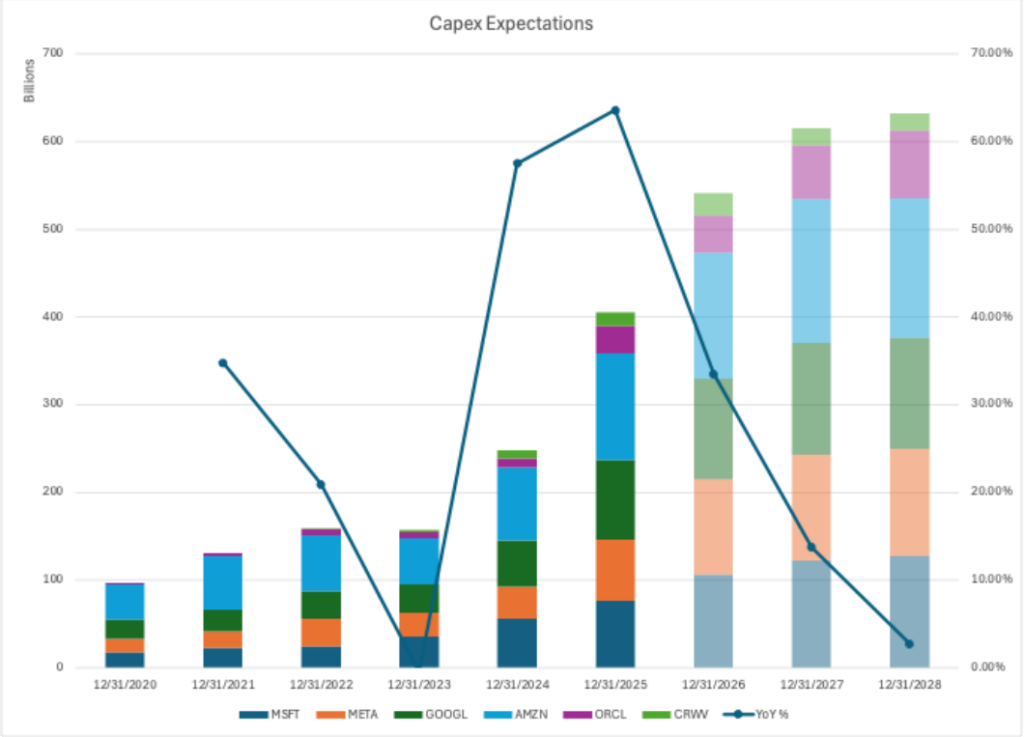
On the variable-cost side, the picture is even more challenging for large tech firms. AI is not a capital-light business. Serving incremental demand requires ongoing investment in data centers, GPUs, networking infrastructure, and electricity. Unlike traditional software, where adding users was nearly free, AI systems incur real marginal costs as they scale.
This combination lower fixed costs and higher variable costs pushes the industry away from natural monopoly economics and toward a more competitive, lower-margin equilibrium.
Capital Intensity: Why AI Monopolies Face the Same Trap as EVs
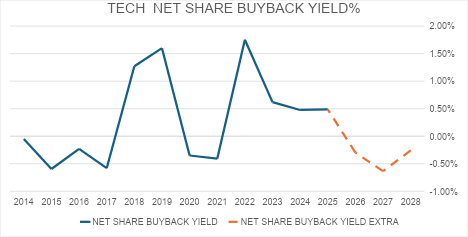
The rapid rise in AI-related capital expenditure highlights a deeper shift in the tech business model. For years, investors rewarded companies that could grow revenues without heavy investment. Free cash flow was abundant, and balance sheets were pristine.
That era is ending.
AI infrastructure spending is accelerating at a pace reminiscent of other capital-intensive transitions, such as renewable energy or electric vehicles. These industries are innovative, fast-growing, and strategically important but they have struggled to generate consistent profits.The lesson is not that innovation is unprofitable, but that innovation alone does not guarantee pricing power. When capacity expands faster than demand differentiation, returns on capital fall. AI risks following this path, especially if multiple players race to build similar capabilities.
AI Slop and the Erosion of Network Effects That Sustain Tech Monopolies
Network effects have long been the most powerful moat in the digital economy. Social media platforms, online marketplaces, and content hubs thrive because users congregate where other users already are. Breaking these networks has historically been difficult.
AI introduces a new vulnerability: content degradation.
As generative systems flood platforms with low-quality, synthetic, or automated material, the user experience deteriorates. Engagement becomes noisier, less authentic, and harder to monetize. Advertisers, already wary of fraud and bot traffic, face diminishing returns on digital ad spend.
Over time, users may respond not by switching platforms, but by opting out of platforms altogether delegating content discovery to AI agents that filter, summarize, and curate information across the entire internet.
This shift would hollow out the value of networks. Platforms would still host content, but they would no longer control access to users’ attention.
From Digital Destinations to Content Warehouses
Today’s internet is organized around destinations. Users visit specific apps or websites to socialize, shop, watch videos, or read news. Control over the destination confers immense economic power.
AI agents threaten to disintermediate this model.
Instead of visiting multiple platforms, users may rely on a single interface that understands their preferences and pulls relevant content from everywhere. In this world, platforms become interchangeable sources of inventory rather than unique experiences.
For content creators, this could be empowering. If AI agents can seamlessly compare monetization terms across platforms, creators gain bargaining power. Revenue sharing may rise, margins may fall, and the economic surplus may shift away from intermediaries.
For platform owners, however, this represents a structural loss of control and profitability.
The “Honest Mechanic” Problem in AI Commerce
One might assume that AI intermediaries would simply replace platform monopolies with new ones. But AI faces a trust constraint that traditional search engines and marketplaces largely avoided.
If users delegate decisions booking travel, choosing products, managing finances to AI agents, they will demand confidence that recommendations are unbiased. An AI known to favor advertisers or hidden sponsors risks losing credibility.
This creates what might be called an “honest mechanic” problem: the more trusted the agent, the harder it is to monetize influence. Unlike traditional advertising, where persuasion operates subtly, AI decisions are explicit and outcome-driven. If the agent is compromised, users will notice.
As a result, AI may compress margins not only for platforms, but also for the intermediaries themselves.
Open Source and the Limits of Proprietary Advantage
Another underappreciated constraint on AI monopolies is the industry’s open-source foundation. Core innovations, research breakthroughs, and development tools are widely shared. Open models provide credible alternatives to proprietary systems, even if they lag slightly in performance.
This outside option caps pricing power. Even dominant firms must compete against “good enough” solutions that are cheaper, customizable, and free from vendor lock-in.
History suggests that when technology diffuses this quickly, monopoly rents are difficult to sustain especially without regulatory protection.
Creative Destruction Comes for Everyone
Technological leadership is rarely permanent. The history of technology is littered with once-dominant firms that failed to adapt to new paradigms. AI represents not just an incremental improvement, but a potential interface shift away from screens, keyboards, and apps toward ambient, voice-driven, and context-aware systems.
If the primary interface to information changes, today’s ecosystem leaders may find themselves poorly positioned, regardless of their current scale. Past success offers no guarantee of future relevance.
Who Captures the AI Dividend?
If AI boosts overall economic output but weakens corporate pricing power, where do the gains go?
Economic theory points to scarce factors of production. When effective labor supply rises whether through automation, software, or robotics the relative value of land, energy, and raw materials increases. AI systems must be built, powered, housed, and supplied. These physical constraints cannot be scaled infinitely or replicated digitally.
As a result, the AI era may favor commodities, infrastructure, and real assets over digital platforms.
Why Mass Unemployment Is Unlikely
Fears of widespread AI-driven unemployment are understandable but likely overstated. While AI may pressure wages in certain sectors, governments have tools to stabilize demand. In a world of high productivity and low inflation, fiscal expansion becomes easier, not harder.
Large budget deficits can support consumption without triggering debt crises, particularly if growth remains strong and interest rates stay contained. The adjustment may occur through income redistribution rather than job destruction.
Investment Implications: Rotation, Not Collapse
The market impact of these shifts is unlikely to be linear. In the near term, momentum, liquidity, and earnings expectations may continue to support tech valuations. But over the medium term, concentration risk rises.
With technology accounting for an outsized share of global equity benchmarks, even modest profit disappointments could have macro-level consequences for consumption and growth.The more durable opportunity may lie in rotation rather than outright risk-off positioning: away from growth concentration and toward diversification, real assets, equal-weight strategies, and emerging markets that benefit from capital-intensive investment cycles.
Conclusion: Innovation Without Monopoly
AI will almost certainly transform the global economy. Productivity will rise, new products will emerge, and entirely new industries will be created. But this does not imply a repeat of the monopoly-driven profit boom that defined the last decade.
Instead, AI may usher in a more competitive, capital-intensive, and physically grounded economic regime one where innovation thrives, but rents are harder to defend.
For investors, the challenge is not to doubt AI’s importance, but to rethink who truly benefits from it.
Where to Build Your Portfolio
You can position your portfolio through the following broker platforms:
REVOLUT:
Easiest option for retail investors. Simple interface, quick access to ETFs, stocks, and commodities.
Trading212:
User-friendly platform offering commission-free stock and ETF investing. Suitable for retail investors seeking straightforward access to global markets.
INTERACTIVE BROKERS: The most professional global trading platform
Most professional global trading platform. Broad asset access, including equities, bonds, futures, commodities, and advanced trading tools.