
This post may contain affiliate links. If you make a purchase through these links, a commission may be earned at no additional cost to you. We only recommend products and services that have been personally tested and are believed to provide genuine value to our audience.
The European Infrastructure Development UCITS ETF is gaining attention as investors reconsider their heavy exposure to U.S. stocks and the weakening dollar. After years of American market dominance, shifting fiscal policy and currency depreciation are prompting global investors to explore new geographic opportunities.
A European Infrastructure Opportunity
For many years, investors didn’t need to think much about geography or currency exposure.
From 2008 to roughly 2025, U.S. markets, particularly the S&P 500 and Nasdaq, consistently outperformed most global indices. At the same time, the U.S. dollar appreciated significantly. As a result, investors who held American technology stocks in U.S. dollars benefited twice: strong equity returns and currency gains.
During this period, the U.S. economy grew faster than most developed nations. Large fiscal deficits and heavy government spending supported expansion. Meanwhile, foreign capital flowed steadily into American markets.
However, the landscape has shifted.
What Changed After 2025?
Since 2025, the U.S. dollar has depreciated sharply. That decline has reduced real returns for international investors holding U.S. assets.
For example:
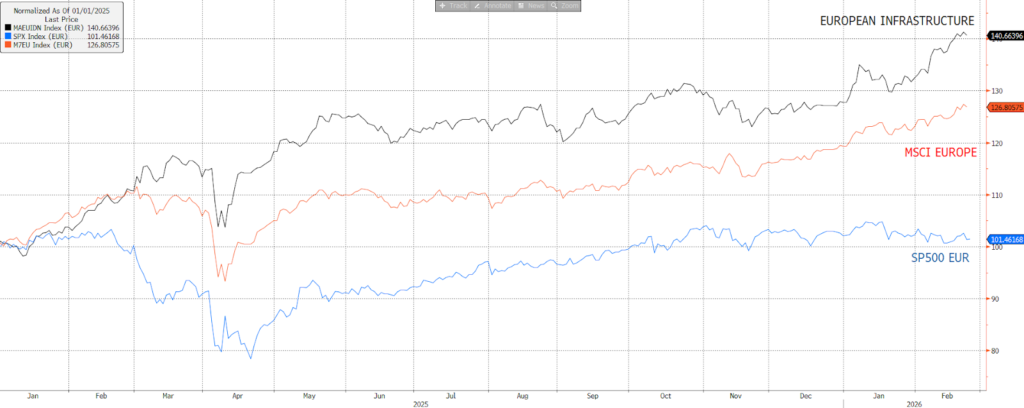
- The S&P 500 is up only about 3% in euro terms since early 2025
- The MSCI Europe Index is up roughly 27%
That gap represents significant European outperformance.
At the same time, U.S. fiscal policy has changed. The current administration has emphasized reducing federal deficits and restructuring trade relationships. A weaker dollar appears to be part of that strategy.
As a result, investors can no longer assume automatic U.S. dominance.
Investment Tip #1: Reconsider Geographic Concentration
If most of your portfolio sits in U.S. assets, especially dollar-denominated equities, you now face currency risk.
When the dollar weakens, foreign investors lose part of their equity gains. Therefore, diversification across currencies matters again.
In this new environment, Europe deserves attention.
Why Europe, and Why Now?
For years, Europe lagged behind. Governments, particularly Germany, avoided large deficits. Infrastructure investment remained limited.
That changed in 2025.
Germany announced plans to invest €500 billion in infrastructure over 12 years. In addition, the European Union committed roughly €300 billion to defense spending.
To put this in perspective, in terms of economic scale, it resembles the U.S. New Deal of the 1930s. In other words, it is transformative.
Although Europe still faces structural challenges, fiscal expansion could drive multi-year growth momentum.
Investment Tip #2: Focus on European Infrastructure Developers
One sector already responding to this shift is European infrastructure development.
Since the announcement of Germany’s €500 billion plan in early 2025:
- European infrastructure development stocks are up roughly 40%
- The broader European market is up around 27%
- The S&P 500, in euro terms, is up about 2-3%
Momentum clearly favors European infrastructure.
Why Infrastructure Has Strong Tailwinds
Germany alone has identified:
- 25,000 km of highways requiring repair
- 5,000 bridges needing urgent replacement
- Major rail system upgrades (Deutsche Bahn struggles with reliability)
- Electric grid expansion
- Energy transition projects
- 5G and digital infrastructure upgrades
Spending will likely accelerate from 2026 to 2027 onward.
Additionally, when reconstruction begins in Ukraine, European infrastructure firms are likely to participate. That adds a potential secondary growth driver.
Investment Tip #3: Consider a Diversified ETF Approach
One way to gain exposure is through the:
- European Infrastructure Development UCITS ETF – Global X ETFs Europe
- Tickers:
- BRIJ (London listing, USD)
- B4IJ (German listing, EUR)
The ETF tracks the MIRAE Asset European Infrastructure Development Index.
Because the underlying assets are euro-denominated, dollar depreciation may enhance returns for investors using the USD listing.
This structure provides both sector exposure and currency diversification.
Valuation and Growth Profile
The ETF tracks the MIRAE Assets European Infrastructure Development Index.
Key fundamentals:
- Expected earnings growth: 12–13% annually for 2026 and 2027
- Forward P/E declines toward the 17–15 range from the current 20 level.
- Dividend yield around 3%, with growth potential
Compared to U.S. large-cap tech valuations, this sector trades at a meaningful discount.
Investment Tip #4: Entry strategy
The sector has strong momentum. However, it may be wise to avoid chasing short-term peaks.
Instead:
- Initiate a position gradually
- Add on 5–10% pullbacks
- Maintain long-term exposure
This strategy reduces timing risk while preserving upside potential.
Macro Confirmation Is Emerging
Recent data support the thesis:
- German manufacturing PMI has moved above 50
- Factory orders are up 13% year over year
- Infrastructure spending appears to be feeding into industrial activity
In other words, fundamentals are beginning to confirm the policy shift.
Where to Buy the ETF
The ETF can be bought via the following broker platforms:
- REVOLUT: Easiest option
- INTERACTIVE BROKERS: The most professional global trading platform
- SAXO BANK: Professional and easy to use
- European Infrastructure Development UCITS ETF – Global X ETFs Europe
Final Takeaway: Diversify Currency and Growth Exposure
For nearly two decades, U.S. equities dominated global returns. That era may not be over, but it is no longer guaranteed.
Today:
- The dollar is weaker
- Europe is expanding fiscal spending
- Infrastructure investment is accelerating
- Valuations remain relatively attractive
Therefore, adding European infrastructure exposure could provide:
- Currency diversification
- Policy-driven growth exposure
- Defensive real-asset positioning
- Potential upside from Ukraine reconstruction
For both U.S. and international investors, this sector may serve as a strategic portfolio component in a changing macro environment.
Disclaimer
This article is for informational purposes only and is not financial advice. Investing involves risk, including possible loss of capital. Please consult a qualified financial advisor before making investment decisions.